Customs Clearance: Concept and Importance
Customs clearance is a mandatory procedure that all goods must go through when entering or exiting any country. The aim of these procedures is to facilitate the movement of global trade by ensuring the payment of required fees and taxes, and compliance with local laws.
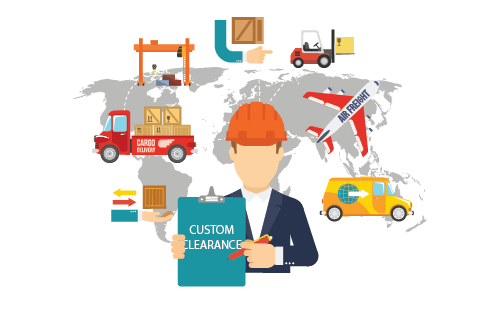
The customs clearance process consists of four main stages:
- Customs declaration: When entering or leaving the country, a declaration must be submitted to the customs authorities, which includes information about the value of the goods, their source, and their destination. Additional documents may be required, such as invoices or a bill of lading. الفواتير or the bill of lading.
- Fee calculation: Customs authorities determine the applicable fees and taxes based on the submitted documents.
- Approval of clearance: If the customs declaration meets the necessary conditions and all fees have been paid, the shipper receives documents proving that the goods have been cleared legally.
- Release of the shipment: After customs clearance, the goods are allowed to continue their journey or be delivered.
Imports are exposed and exports International imports and exports, including commercial shipments, are subject to customs clearance. Individuals or companies can arrange this, but in the case of international sea shipping, goods must undergo customs procedures in each country. Therefore, a specialized customs broker is often hired to facilitate this process.
Customs declaration
The completed customs declaration is considered an essential part of the customs clearance process. It is usually submitted electronically and includes important information about the goods crossing the borders during operations. Import or export. If the declaration does not meet the required conditions, goods may be detained for inspection or further information may be requested, so it is common to resort to professional customs brokers to complete these procedures.
Customs broker
The customs broker plays an important role in facilitating the customs clearance process when importing or exporting goods across borders. It ensures The Mediator To ensure that things run smoothly, so that shipments reach their destination without unjustified delays. Individuals or companies can appoint a broker to handle the administrative tasks related to customs clearance, such as verifying the accuracy of documents and arranging for the payment of fees. Customs brokers have extensive experience in local laws and regulations, which helps avoid mistakes and ensures a smooth process.
Customs clearance services
Due to the complexity of customs regulations, many companies rely on customs brokers to help manage this aspect of their business operations, in order to avoid any delays or issues. Customs clearance services include:
- Preparation of customs documents, correction of errors, and ensuring that no information is missing.
- Ensuring compliance with customs laws in the destination country.
- Providing advice on trade agreements that may help reduce fees and taxes.
- Paying the fees and taxes on behalf of the importer to facilitate the process.
- Contacting the relevant authorities to resolve any issues that may arise.
- Providing support after clearance, such as auditing, compliance, and record-keeping.
In general, the use of customs clearance services is considered an important step in improving the effectiveness of international business operations.
Determining the type of customs clearance
The choice of the appropriate type of customs clearance is influenced by several factors:
- The nature of the goods: The quality of the imported or exported goods can determine the required procedures.
- Purpose of trade: The end use of the goods and their destination can affect the type of clearance.
- Regulatory requirements: Each type of clearance has unique regulatory requirements that must be adhered to.
Essential documents for customs clearance
The required documents for customs clearance from the exporter and importer include the following:
From the source:
- The commercial invoice: contains details of the products, the cost, and shipping information.
- Export license: Authorizes the company to export goods.
- Package statement: A list of the contents of the shipment.
- Bill of Lading: Confirms the contract of carriage of goods and its details.
- Certificate of Origin: Shows the country of manufacture of the goods.
- Bill of Sight document: Allows verification of the nature of the goods before payment.
From the importer:
- Tax card: It verifies the identity of the importer for tax purposes.
- Commercial or industrial registration: It proves that the importer is legally registered.
- Customs Handling Card: Allows the importer to deal with customs.
- Delegation For the customs broker It allows him to represent the importer before customs.
Customs clearance process
The customs clearance process is a set of necessary procedures that must be followed to ensure the legal and safe transport of goods across borders. This process includes several key steps:
- Tax Information Confirmation: This step involves verifying the tax information of the importer and exporter, ensuring that all required fees and taxes are accurately calculated.
- Determining the source of import and the destination of export: The source of the imported goods and their destination upon export must be clarified, along with the mode of transportation used.
- Collecting shipment details: This requires obtaining accurate information about the shipment, including the quantity, size, description of the goods, their source, and the manufacturer.
- Clarification of inspection requirements: The inspection requirements related to the shipment must be specified, and the necessary certificates must be obtained to confirm that the products have passed the required tests.
- Payment of Due Taxes: The payment of due fees and taxes is considered a fundamental step in the customs clearance process.
Who is responsible for customs clearance?
The responsibility for customs clearance primarily falls on the importer or exporter. However, a customs clearance agent can be appointed to take on these tasks. The customs clearance agent acts as an intermediary between the client and the customs authority, managing the processes and procedures related to customs clearance, and their responsibilities include:
- Supervising communication between parties: The customs broker acts as a link between the client and the customs authorities.
- Information transfer: It transfers updates and requirements from the customs office to the client.
- Tax and Fee Payment Management: Oversees all payments related to taxes and fees for the importer or exporter.
- Compliance with requirements: Ensures adherence to all applicable standards, laws, and regulations for both parties.
Who bears the customs fees?
The importer or the consignee usually bears the responsibility for paying customs duties and taxes. While the two parties (the buyer and the seller) can agree in advance on who pays, it is typically the importer who incurs these costs in most cases. It is important for those involved in international shipping to understand the responsibilities related to paying duties, deadlines, and acceptable payment methods, which may vary from country to country.
Other important factors to consider for customs clearance
- Restrictions on import/export activities: It must be ensured that there are no restrictions or bans on goods in the relevant countries. For example, if there is a shipment you wish to import to Senegal, you must ensure that it is possible to ship and receive these goods in the destination country.
- Understanding Trade Agreements: It is essential to understand trade agreements between countries, as these agreements can affect the tariffs imposed on imports and exports.
Conclusion
In conclusion, the customs clearance process is essential to ensure the legal and safe transport of goods across borders. By adhering to the required procedures and understanding the requirements, importers and exporters can facilitate their business operations and avoid potential issues. Collaborating with customs clearance agents also helps achieve smoothness in these processes.