What is a Proforma Invoice?
The pro forma invoice is considered an important document in the world of commerce, as it represents the preliminary form of the final invoices expected to be issued after the completion of the sale and purchase process. This invoice is sent by the producing or exporting company to the client as a proactive step, helping them understand the costs and prices associated with the purchasing process, whether in the context of local operations or in fields Import and export، Which facilitates financial planning.
The pro forma invoice includes comprehensive details about the goods or services provided, including their quantities, prices, and any additional relevant information. Although it is similar to the final invoice, it does not carry any stamp or signature, and therefore is not considered an official or legal document, nor does it entail any judicial provisions.
In summary, the pro forma invoice is a valuable tool in facilitating commercial transactions and providing the necessary information to the buyer before completing the deal.
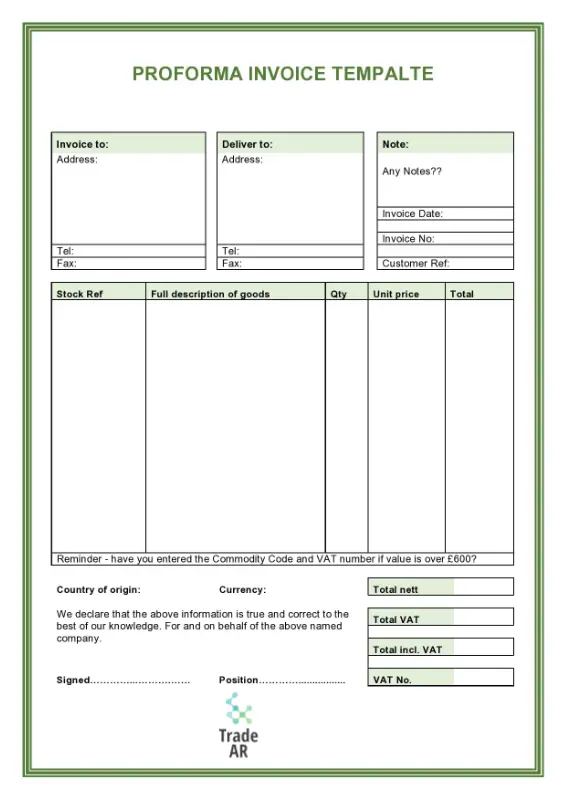
The purpose of the pro forma invoice and its importance
- Providing clarity and transparency: The pro forma invoice aims to ensure that the terms and conditions are clear to both parties by specifying the details of the goods or services, unit prices, quantities, and any additional fees. This helps to avoid misunderstandings and future disputes.
- Providing a detailed price quote: Through the initial invoice, the seller can present a detailed price quote, allowing them to market their products effectively. This creates an atmosphere of trust and reassurance between the two parties by providing a clear presentation of price details and product specifications.
- Facilitating decision-making: The pro forma invoice plays an important role in helping buyers and sellers make informed decisions. For buyers, it provides an accurate estimate of the total cost, while it helps sellers showcase their products and demonstrate their value.
- Accurate Cost Estimation: The pro forma invoice allows the buyer or importer to estimate costs accurately, helping them conduct a thorough feasibility study of the business transaction.
- assistance in Customs clearancePro forma invoices are essential in international trade, as they provide customs authorities with detailed information about the goods, facilitating the customs clearance process and reducing delays.
- As a preliminary agreement: In some cases, the pro forma invoice can be used as a preliminary agreement between the buyer and the seller, allowing them to initiate the transaction quickly without the need for a formal contract.
Components of the Proforma Invoice
The preliminary invoice consists of several key components that ensure the clarity and smoothness of the transaction. These components include:
- Company Information: The invoice must include details of the issuing company, such as the name, address, and contact information. This information is essential to ensure effective communication between the seller and the buyer.
- Client Information: It is also important to include the details of the client receiving the invoice, including their name, address, and contact information. This helps avoid any confusion and ensures that the invoice can be easily referenced.
- A detailed list of goods or services: Accurate details about the goods or services provided must be presented, with each item listed separately. This includes the description, quantity, unit price, and total price. This enhances transparency and allows the buyer to understand what they are being charged for.
- Terms and Conditions: It is essential to include the terms and conditions related to the sale, such as payment due dates, payment methods, and conditions . الشحن. This helps both parties establish clear expectations and avoid any misunderstandings.
- Total amount due: The invoice must clearly state the total amount due, including any taxes or fees. This amount should be calculated based on the detailed list of goods or services.
- Additional Information: Depending on the nature of the transaction, there may be additional information that needs to be included, such as special instructions or delivery details. This provides further clarity and helps avoid any confusion.
- Price validity date: The validity date of the price displayed on the invoice must be clarified to ensure the customer is aware of the duration of the prices.
- Issue date and due date: The invoice issue date and payment due date must be specified to ensure clarity in the timelines.
- Display the value of the value-added tax: The expected value of the value-added tax, if any, should be included to ensure transparency in costs.
- Description of the filling method: The method should be clarified Product packaging To avoid any issues during the shipping process.
- Shipping duration: The approximate time frame for shipping and the arrival of goods at their destination should be mentioned.
In summary, the initial invoice should contain comprehensive information about the company and the client, a detailed list of goods or services, terms and conditions, the total amount due, as well as any additional relevant information. Including these components ensures smooth communication and facilitates transactions for both parties.
How to Create an Effective Proforma Invoice
- Include accurate information: Include precise details such as billing and shipping addresses, contact methods, along with a unique invoice number and date.
- Payment terms: Clearly specify the accepted payment methods, deadlines, and any special conditions such as advance payments.
- Defining the scope and purpose: Clarify what the invoice includes, such as goods or services, quantities, and prices, to ensure both parties agree on the costs.
- Product or service description: Provide a detailed description of each item, including quantities and prices, to help the customer understand what they are paying for.
- Using professional templates: Use consistent designs that reflect your brand identity, enhancing your credibility and making the invoice easier to recognize.
Tips for Creating Effective Proforma Invoices
- Include relevant details: Be sure to specify the goods or services, prices and quantities, and any discounts or taxes.
- Use a professional design: Make the invoice organized and professional, including the company logo and contact information.
- Clearly define the terms: Specify the payment and delivery conditions to avoid any ambiguity.
- Providing contact information: Within the contact information to enable the buyer to inquire easily.
By following these steps, you can create a preliminary invoice that helps simplify billing processes and enhance customer satisfaction.
The essential features of the pro forma invoice
The preliminary invoice is characterized by a set of features that make it unique, including:
- Absence of an official number: The preliminary invoice lacks any official number, which distinguishes it from final invoices.
- Clarity of its nature: The invoice should contain a statement clearly indicating that it is a preliminary invoice, such as "Invoice Template".
- Absence of stamps and signatures: The initial invoice does not contain official stamps or signatures, which means it is not legally approved.
These features help to define the nature of the initial invoice, ensuring that the parties involved clearly understand its legal status.
Benefits of the Proforma Invoice
The pro forma invoice is considered an important tool in the business world, as it contributes to:
- Facilitating mutual understanding: The pro forma invoice helps create a clear understanding between the buyer and the seller before the final invoice is issued, which helps reduce the chances of misunderstandings or future disputes.
- Providing a Quote: The pro forma invoice is an effective way to present a comprehensive estimate of the costs of goods or services, helping businesses with planning and budgeting.
- Facilitating customs clearance: Proforma invoices provide detailed information about the goods, enhancing the customs clearance process and speeding up shipping procedures.
Relationship of the initial invoice to the preliminary invoices
Simplifying billing processes
Preliminary invoices contribute to improving the efficiency of billing processes, making them a crucial step in preparing final invoices. Here’s how preliminary invoices can facilitate this process:
- Ensuring accuracy and transparency: Pro forma invoices provide detailed information about the goods or services rendered, including costs. This helps clarify matters between the seller and the buyer.
- Avoiding discrepancies: By providing clear and detailed information, preliminary invoices can reduce the gaps between the services rendered and the final invoices, which helps to minimize delays in payments.
- Accelerating the issuance of final invoices: Preliminary invoices help speed up the process of preparing final invoices by providing a quick estimate that allows both parties to agree on the terms before work begins.
The difference between a pro forma invoice and a commercial invoice
| Proforma Invoice | Commercial Invoice | |
|---|---|---|
| legal weight | You do not have legal weight | It has legal weight |
| Commitment to payment | Do not obligate the importer to pay | Obligates the importer to pay |
| Tax refund | It cannot be used to recover value-added tax. | It can be used to recover value-added tax |
| Invoice Requirements | does not meet the legal requirements | Meets the legal requirements |
Common Mistakes When Using Proforma Invoices
Despite the benefits of initial invoices, there are some mistakes that should be avoided:
- Failure to clearly specify the document: The invoice should be clearly labeled as a preliminary invoice to avoid any confusion.
- Providing inaccurate information: Verifying the accuracy of information before sending the invoice is vital to avoid objections from customers.
- Failure to include necessary information: It is important to ensure that all essential details are included, such as product descriptions and pricing.
- Using the pro forma invoice as an actual invoice: pro forma invoices should be used as preliminary documents only, and not as official invoices.
- Failure to follow up after sending: It is essential to follow up with customers to address any inquiries they may have.
Conclusion
The pro forma invoice is a key tool in the invoicing process, as it helps improve mutual understanding between parties, provides accurate estimates that ensure transparency, and facilitates customs operations in various fields. Commercial brokerage and import and export. By avoiding common mistakes, companies can enhance the effectiveness of this document, contributing to greater success in international business.